
The Hue Thien Mu Pagoda, a famous tourist attraction in Hue, Vietnam, is surrounded by tranquil scenery and rich foliage as it stands elegantly on the Perfume River’s northern bank. Thien Mu Pagoda, also called the “Pagoda of the Celestial Lady,” is a historical and cultural landmark that has been essential to the intricate history of Vietnam. Furthermore, it’s a site of great religious significance. The Thien Mu Pagoda known as Hue Linh Mu Pagoda is still a standing example of the region’s rich cultural and historical heritage as well as Vietnamese Buddhism. Hue’s timeless pagoda, with its calm surrounds and hallowed halls providing guests with inspiration and solace, is a must-visit location for anybody interested in learning more about Vietnam’s rich cultural legacy.

Echoes of Enlightenment: Exploring the Tranquil Legacy of Thien Mu Pagoda
Show table of content
- 1. Scenic Location
- 2. Thien Mu Pagoda history
- 3. Architectural Marvel of Thien Mu Pagoda
- 4. What to see in Thien Mu Pagoda
- 4.1 Phuoc Duyen Tower
- 4.2 Dai Hong Chung Bell & Giant Turtle
- 4.3 Three-Doors Gate & Dai Hung Shrine
- 4.4 Immortal Austin Car & Thich Don Hau Tomb
- 5. Art and Culture of Thien Mu Pagoda
- 5.1 Buddhist Art in Thien Mu
- 5.2 Cultural Festivals
- 6. Best time to visit
- 7. How to get to Thien Mu Pagoda?
- 8. Join Hue City Tour from Da Nang
1. Scenic Location
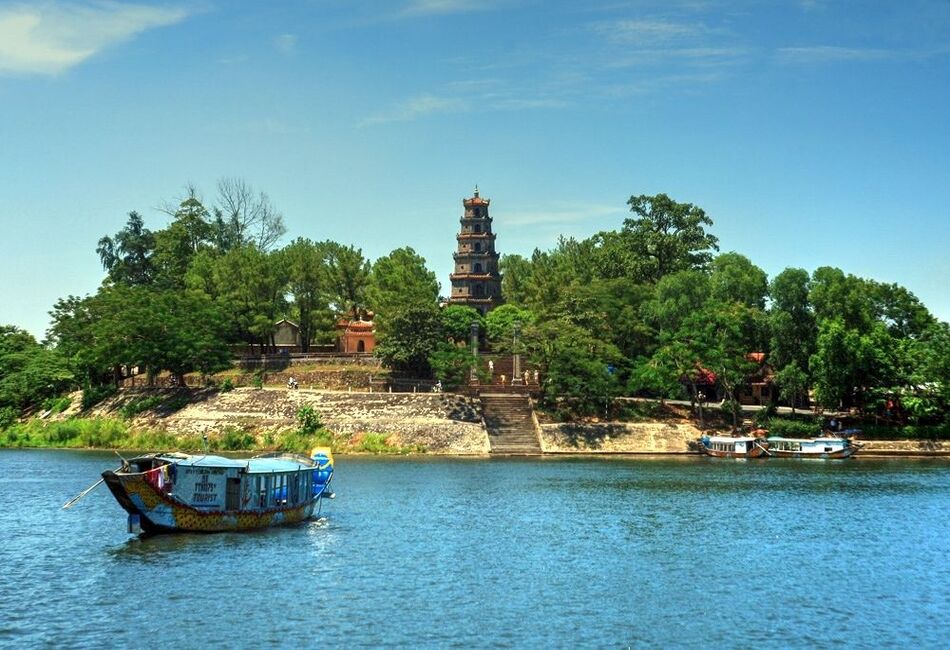
The best preserved national cultural treasures can be found in Hue. One of these treasures is the Hue Thien Mu Pagoda. It is notable for its holiness, old architecture, and mythology, which is full of strange historical tales. It’s situated on Ha Khue Hill, which is a part of An Ninh Thuong village, Kim Long Ward, Hue City, Thua Thien Hue Province. Please note that the Thien Mu Pagoda entrance fee is free of charge.
2. Thien Mu Pagoda History
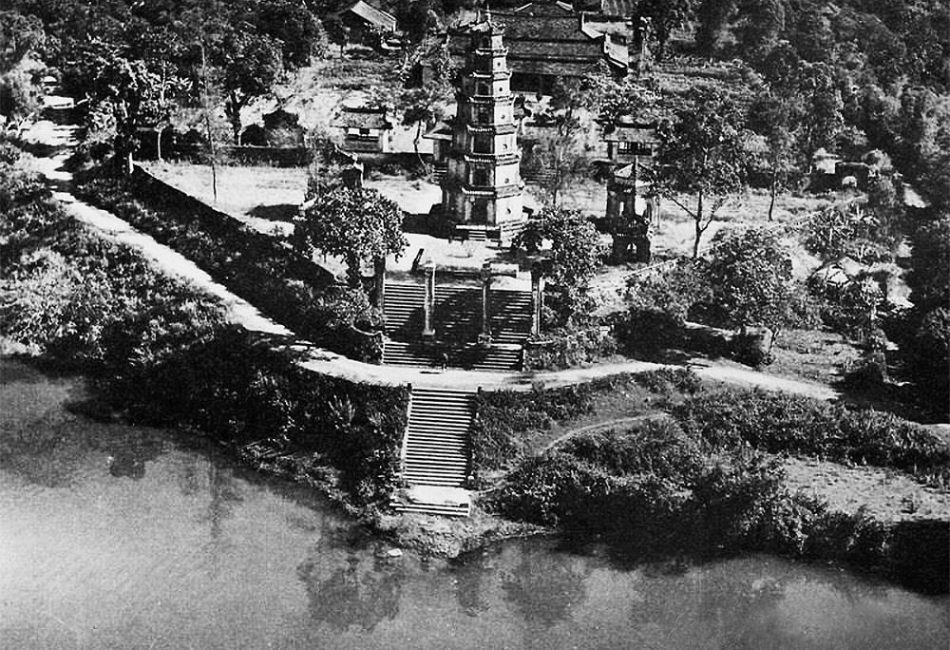
Thien Mu Pagoda history started when it was built in 1601 by Lord Nguyen Hoang, the first Lord of the Kingdom of Annam (Outer Land). Hue Thien Mu Pagoda, also known as Hue Linh Mu Pagoda, is the oldest pagoda in Hue. Numerous records state that before entering the Thuan Hoa Citadel to determine the future of the Nguyen family’s money and career, Lord Nguyen Hoang personally surveyed the terrain. As he raced down the Huong River, he saw Ha Khe, a little hill rising along the blue river, looking like a dragon’s head turning. Locals began spreading the rumor of an elderly woman with a pleasant face and a red shirt simultaneously. She goes to Ha Khue hill every night and tells everyone that a devoted Lord is going to build a temple to protect the dragon veins. Sensing that the narrative mirrored his concept, Nguyen Hoang gave the soldiers the order to erect a pagoda on the hill right away. The pagoda was given the name Thien Mu Tu at this point, which translates to “the midwife of heaven.”
Fearing that the word “Thien,” which signifies heaven, would anger it and keep him from bearing children to carry on the lineage, King Tu Duc renamed the pagoda Linh Mu in 1862. The fourth ruler of the Nguyen Dynasty did not permit the name Thien Mu to be used again until 1869. Nonetheless, while discussing this historic pagoda, many still refer to it by both names today.
The Thien Mu Pagoda has already undergone numerous repairs. Among the most important repairs happened when Lord Nguyen Phuc Chu was in office (1691 – 1725). At this point, Lord Nguyen Phuc Chu gave the order to cast a bell with an inscription inscribed on it that weighed more than two tonnes. He restored the Thien Vuong Palace, the Thuyet Phap mansion, and the Tang Kinh Cac around 1714. More precisely, he dispatched individuals to purchase over a thousand sets of Buddhist scriptures from China. He paid respect and homage to the Buddha’s philosophy. Additionally, he stored all of the sutras in Tang Kinh Cac, which is said to be a repository for Nguyen Dynasty archives. Furthermore, a comprehensive collection of scriptures exists about Venerable Thach Liem, a man widely acclaimed for his contributions to the Nguyen Dynasty’s efforts to revive Buddhism in the Inner Land.
3. Architectural Marvel of Thien Mu Pagoda
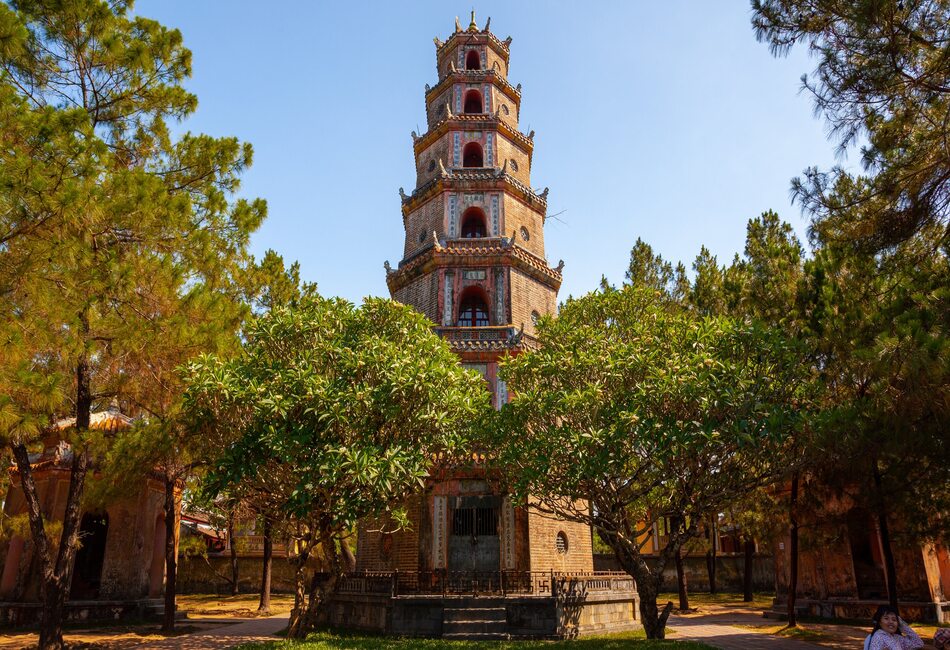
A fine representation of traditional Vietnamese Buddhist architecture is the Hue Thien Mu Pagoda. The Phuoc Duyen Tower, an octagonal tower rising to seven stories and perched on a granite terrace, is its most noticeable feature. With a blend of Chinese and Vietnamese features, the tower’s exquisite design and detailed carvings demonstrate the merging of Buddhist and Vietnamese architectural styles. A calm courtyard with ponds, beautiful bonsai plants, and scented frangipani trees can be found at the foot of the tower. A verdant garden encircles the entire complex, adding to the overall tranquility and tranquility. The architecture of the pagoda blends in perfectly with the surrounding environment, transforming the area into a spiritual haven for pilgrims and visitors alike.

4. What to see in Thien Mu Pagoda?
4.1 Phuoc Duyen Tower
From a great height, the holy Hue Thien Mu Pagoda appears to be turning its massive back like a big dragon. The Phuoc Duyen Tower is seen from the Perfume River. In 1844, the Tu Duc Emperor gave his grandmother this gift as a birthday present. One unique feature of this tower is that each story has a Buddha statue facing southward. You can see a spiral staircase inside the tower that goes to the top floor, where there used to be a golden Buddha statue on exhibit.
4.2 Dai Hong Chung Bell & Giant Turtle
Gazing at the left and right corners of Hue Linh Mu Pagoda, tourists can appreciate the magnificence of the enormous marble turtle, constructed in 1675. As you are aware, one of Vietnam’s four sacred creatures is the turtle, the representation of wisdom and longevity. For this reason, some students come here to touch the turtle’s head in hopes of receiving good luck before exams. The turtle’s back has a stele honoring Lord Nguyen Phuc Chu’s renovations. The words written by the Lord on the stele depict the new structures of the pagoda and give thanks to Buddhism and the monk who assisted the Lord in bringing Buddhism to the area. A pavilion with a massive bronze bell named Dai Hong Chung is located on the left. Given its proportions, the 1710-cast bell ranks among Vietnam’s greatest bronze-casting accomplishments of that era. It is 4.5 feet high, weighs close to 6,000 pounds, and can be heard up to 6 miles away.

4.3 Three-Doors Gate & Dai Hung Shrine
Behind Phuoc Duyen Tower, is the main entrance of Hue Thien Mu Pagoda. The human, the demon, and the god worlds are divided into three roads that lead from the gate. There are eight roofs and two stories in the gate. The middle gate’s second story is home to a Buddhist shrine. Specifically, the top of the roof has numerous unique patterns engraved into it. The Dharma Protector statues are simultaneously watching over the gate from both sides. We shall get to Dai Hung Shrine by passing through the Three-door gate with the twelve holy guardians. Three Buddha statues, representing the past, present, and future—three human lives—are worshiped and prayed to at the sanctuary shrine. Additionally, Buddhist monks worship there.

4.4 Immortal Austin Car & Thich Don Hau Tomb
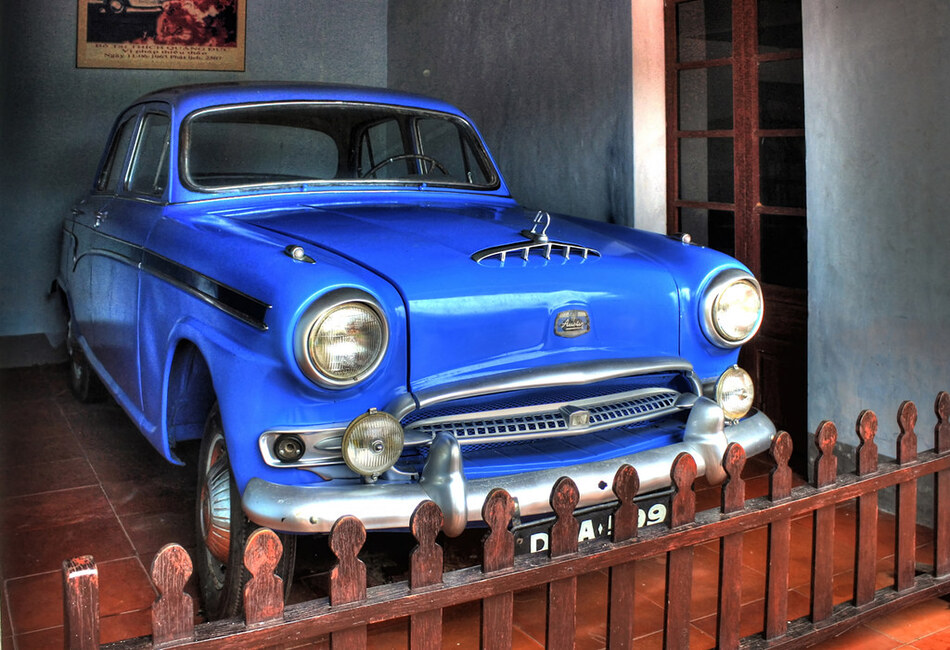
We will come upon a lovely rockery as we stroll to the rear. It serves as an air conditioner in addition to décor as well as to produce warmer summer temperatures and colder winter temperatures. There are loads of amazing bonsai trees in the spacious yard. In the Hue Thien Mu Pagoda, every monk tends to one. An Austin automobile can be seen a little ways away. Thich Quang Duc Monk’s automobile, when he set himself on fire in 1963 to protest the Ngo Dinh Diem regime. requesting that individuals be allowed to practice Buddhism.
Most honorable in the pagoda, Thich Don Hau was a well-known abbot. His entire life was dedicated to the advancement of Buddhism in Vietnam. He also earned the respect of the populace by performing several volunteer acts in the community and aiding those in need. To show their deep thanks to the esteemed monk, locals, and pagoda administrators buried the Venerable under the tower at the end of the campus when he died away.

5. Art and Culture of Thien Mu Pagoda
5.1 Buddhist Art in Thien Mu
The Hue Thien Mu Pagoda showcases customary Vietnamese Buddhist artwork and building design and visitors can take Thien Mu Pagoda photos. There are several different buildings in the temple complex, including the main sanctuary, towers, pavilions, and courtyards. As is common with many Buddhist temples in Vietnam, the architecture is a fusion of Chinese and Vietnamese forms. The Thien Mu Pagoda features a variety of Buddhist artwork, such as sculptures, paintings, statues, and ornamental pieces. The rich cultural and religious legacy of Vietnam is reflected in the artwork of Thien Mu Pagoda, which places a particular emphasis on Buddhist teachings and symbolism. When visiting the pagoda, visitors can take in the complex’s exquisite craftsmanship and artistic displays as well as the calm, meditative environment.
5.2 Cultural Festivals
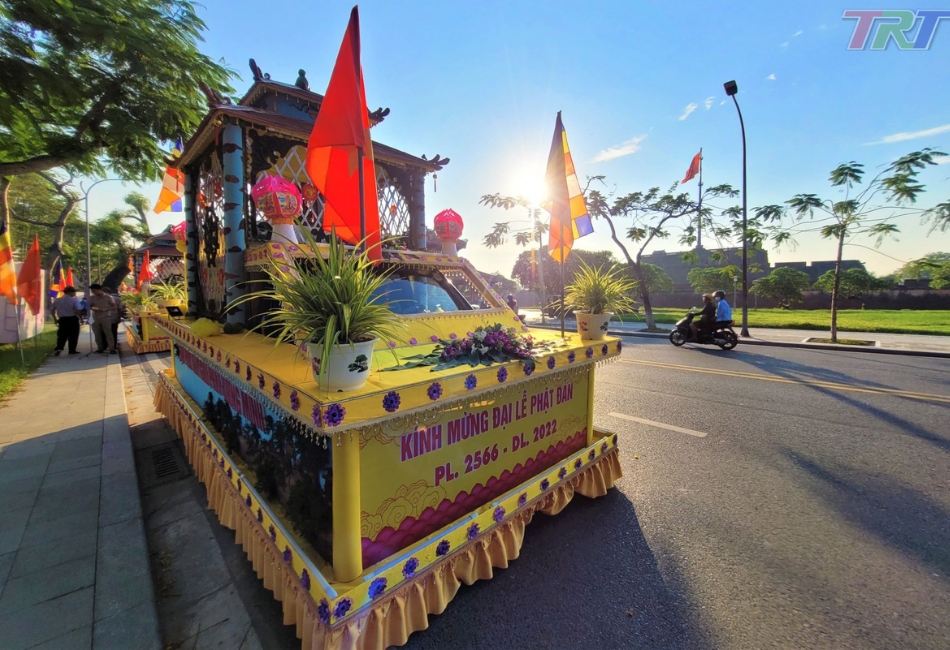
At Hue Thien Mu Pagoda, one of the most anticipated occasions is the Buddha’s Birthday Festival, or “Phat Dan” as it is known in Vietnamese. Every year on the eighth day of the fourth lunar month, this celebration takes place. Numerous ceremonies, colorful processions, and prayers highlight the celebrations, which attract a sizable number of local and foreign guests. The pagoda is decked out in vibrant decorations for the festival, and devotees travel great distances to present prayers, incense, and flowers to Buddha. It is a period of intense introspection, community togetherness, and spirituality. It also allows outsiders to see how vibrant Vietnamese religious customs are.
Immersion in Vietnam’s rich spiritual and cultural heritage is possible only by visiting Hue Linh Mu Pagoda during the Buddha’s Birthday Festival. During this time, the pagoda transforms into a center of happiness and good vibes, making it an unforgettable and instagramable occasion for everyone in attendance.
6. Best time to visit
Facts about Hue Thien Mu Pagoda and the experiences of many travelers suggest that there are two best times to visit the pagoda: in January and February, and in May and June. You can enjoy lovely weather in January and February, with chilly temps and a little bit of rain. On the other hand, you can see red phoenix flowers blooming in the sky if you visit Hue Linh Mu Pagoda between May and June.

7. How to get to Thien Mu Pagoda in Hue
With just 5 km separating Thien Mu Pagoda from Hue’s downtown, getting there is simple and may be accomplished by rental motorbike, cyclo, private car or taxi. You can rent a motorcycle and take the route: Kim Long Street out of Hue’s Imperial City, if you want to travel alone. Continue for approximately 2 km to arrive at Thien Mu Pagoda. A motorbike can be rented for between 100,000 and 150,000 VND per day. If you’re planning to visit by boat, travel to Thien Mu Pagoda via a dragon boat. It only requires half an hour. As a result, you could take pleasure in the refreshing wind that blows along the Huong River’s banks.
Visiting Thien Mu Pagoda from Da Nang? Booking a private car from Da Nang to Hue is your best bet! Enjoy a safe and smooth ride with modern vehicles and professional, English-speaking drivers who ensure your trip is both comfortable and unforgettable.
8. Join Hue City Tour from Da Nang
Admire the seven-story Hue Thien Mu Pagoda, which is perched elegantly on the banks of the Perfume River. Travelers from all over the world are drawn to this revered location, also known as the Pagoda of the Celestial Lady, because of its fascinating architectural design, cultural significance, and long history.
The ultimate Hue day trip by heritage train is officially trending! Soak in unreal, viral-worthy views of Hai Van Pass right from your window, explore iconic historical spots, and dive into Hue’s famous food scene.
Join us on this fascinating tour of Hue City from Da Nang, where the attractions of nature, culture, and history come together. Savor the distinctive flavors of Hue’s culinary pleasures, take a trip down the Thien Mu Pagoda, and lose yourself in the magnificence of imperial monuments. Allow each km to take you one step closer to Hue’s alluring embrace of history.
Thien Mu Pagoda stands as a timeless symbol of spiritual devotion and cultural heritage in Hue, Vietnam. With its elegant architecture, serene setting along the Perfume River, and rich history dating back over four centuries, Thien Mu Pagoda continues to captivate visitors from around the world. Its significance as both a religious site and a historical landmark underscores its enduring importance in the cultural landscape of Hue and highlights its role as a cherished destination for travelers seeking tranquility, enlightenment, and a deeper connection to Vietnam’s spiritual traditions.


Comment (0)